
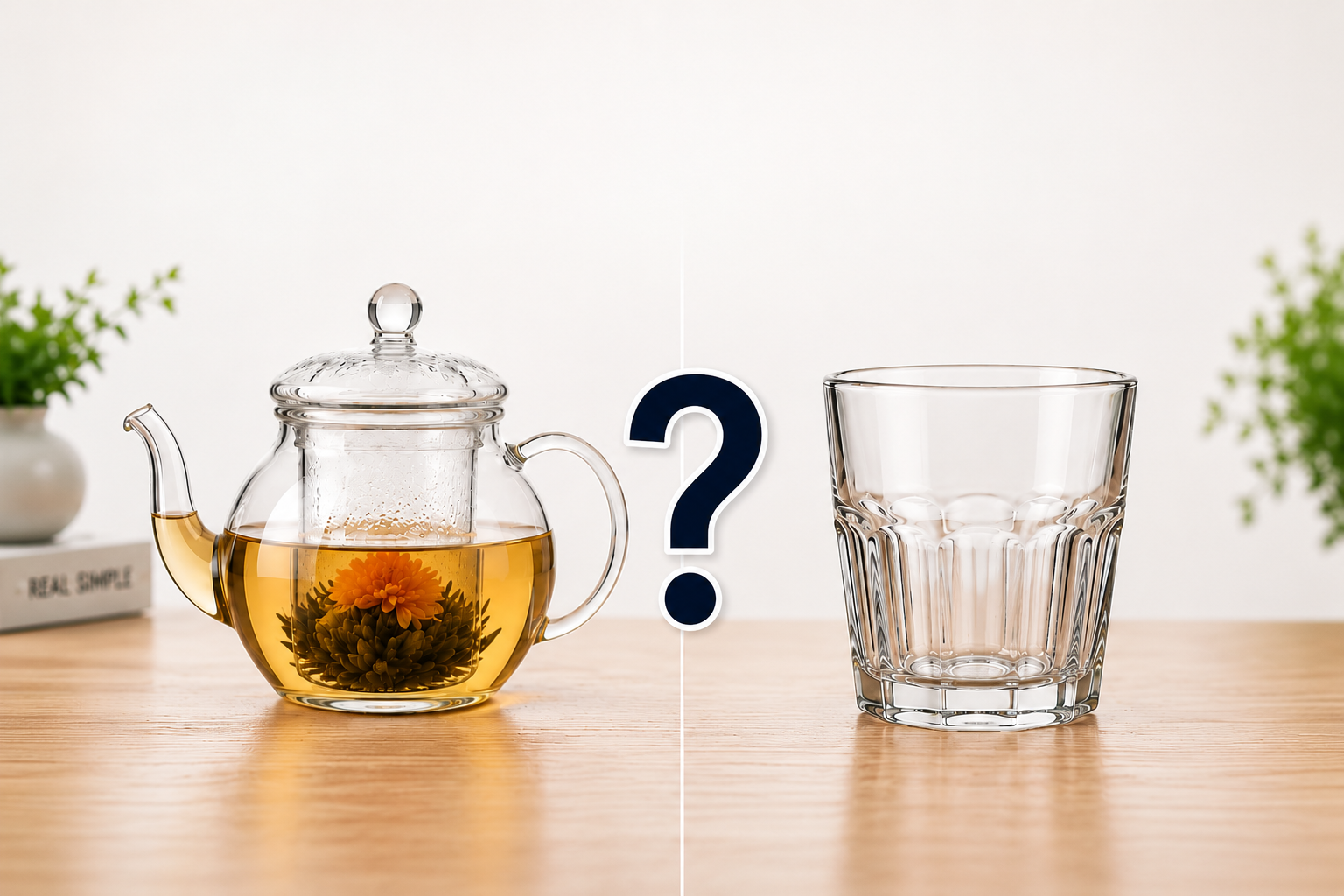
Why Do Some Glass Products Require 30,000pcs MOQ, While Others Need Only 500pcs?
Have you ever wondered about this?
Both are glass products.
Why can some products be made with only 500 or 1,000 pieces, while others require 3,000, 10,000, or even 30,000 pieces before a factory will accept the order?
Why does one supplier say “500pcs is okay”, while another insists that “30,000pcs is the minimum”?
If they are all made of glass, what makes such a big difference?
Many buyers assume that the more complicated a product looks, the higher the MOQ should be.
But after many years working with glass kitchenware at Sunshine Glass, I have found that the reality is often the opposite.
Some very complex glass products can be produced in small quantities, while some very simple products require huge volumes.
The reason is simple:
MOQ is usually decided by the production process, not by how complicated the product looks.
1. Automatic Production Usually Means Higher MOQ
Many common glass products are made by automatic machines.
Typical examples include:
- Glass storage jars
- Oil bottles
- Large beverage dispensers
- Drinking glasses
For these factories, the biggest cost is not labor.
The real cost comes from changing molds, adjusting machines, and keeping production lines running efficiently.
In addition, glass furnaces usually run 24 hours a day. Once production starts, stopping and restarting the furnace creates extra time, energy, and production costs.
There are two common automatic production methods.
IS Machine Production
This method is often used for soda-lime glass storage jars, bottles and dispensers.
In principle, a production run usually requires around 30,000 pieces.
However, factories can sometimes combine several products into the same production schedule.
In that case, the MOQ for each item may be reduced to around 10,000 pieces.
Press Machine Production
This method is commonly used for soda-lime drinking glasses.
The molds often have 18 to 24 cavities, meaning many glasses are produced at the same time.
Because drinking glasses are usually low-margin products, factories prefer large-volume production and are often unwilling to combine different orders.
As a result, the MOQ is commonly around 30,000 pieces.
A Special Case: Glass Food Containers
Glass food containers are a little different.
The actual production quantity is often even higher, sometimes 30,000 to 50,000 pieces.
However, because these products are relatively standard, factories often produce them in advance and keep them in stock.
This allows them to sell from inventory later, making the MOQ much more flexible for buyers.
2. Handmade Borosilicate Glass Often Has Lower MOQ
Now let’s look at another category.
Products such as:
- Double-wall glass mugs
- Glass teapots
- Borosilicate storage jars
- Creative kitchenware
are often made from glass tubes by skilled workers using flame processing.
This production method is very different from automatic production.
Factories can arrange production according to orders and stop or restart production much more easily.
They do not need large automatic production lines running continuously.
Because of this, MOQ requirements are usually much lower.
It is common to see MOQs of 500, 1,000 or 3,000 pieces.
Interestingly, these products often look much more complicated than machine-made glass products.
However, there is one exception.
Some popular borosilicate products, such as certain glass kettles and pitchers, were originally handmade.
As demand increased, some factories developed automatic production methods for them.
Automatic production helps reduce costs, but it also increases MOQ requirements.
In many cases, the MOQ usually higher than 30,000 pieces.
The mold cost is also very different.
For automatic production, molds may cost USD 3,000–5,000.
For many handmade borosilicate products, molds may cost only around USD 100.
3. Sometimes MOQ Is Decided by Decoration or Accessories
In some cases, the glass itself is not the problem.
The real limitation comes from decoration processes or accessories.
For example:
- Decals
- Silk printing
- Spray coating
- Electroplating
Before production starts, these processes often require plate making, color matching, sampling and testing.
These preparations create fixed costs.
If the quantity is too small, the cost per piece becomes very high.
As a result, decoration suppliers often have their own minimum production quantities, which can directly affect the final MOQ.
Accessories can create the same situation.
Take lids as an example.
At Sunshine Glass, we often see this with food storage containers.
The glass container itself may already be available from stock.
However, custom-colored plastic lids or special glass lids are often not.
If the lid factory needs to start a production run, they may require 3,000 pieces as the minimum quantity.
In this situation, the MOQ is not decided by the glass container.
It is decided by the lid.
This is why some food storage containers can only be ordered in quantities of 3,000 pieces when custom-colored lids are required.
Final Thoughts
A simple glass product may require 30,000 pieces.
A complex glass product may require only 500 pieces.
After many years in this industry, I have learned that MOQ is rarely decided by how a product looks.
The real answer is usually hidden behind the production process.
So the next time you receive an MOQ from a supplier, don’t only look at the product itself.
Try to understand how it is made.
Very often, that’s where the answer is.
About Sunshine Glass
Sunshine Glass is a supplier of borosilicate glass kitchenware based in Qingdao, China.
We specialize in glass food containers, storage jars, bottles, pitchers and custom glass kitchenware for brands, importers and retailers worldwide.
Lisa Wang